Termite Swarmers vs. Flying Ants: Spring Identification Guide for Tennessee Homeowners
Discover how to tell the difference between termite swarmers and flying ants in Middle Tennessee. Learn the three key physical indicators, behavioral clues, and what to do next.
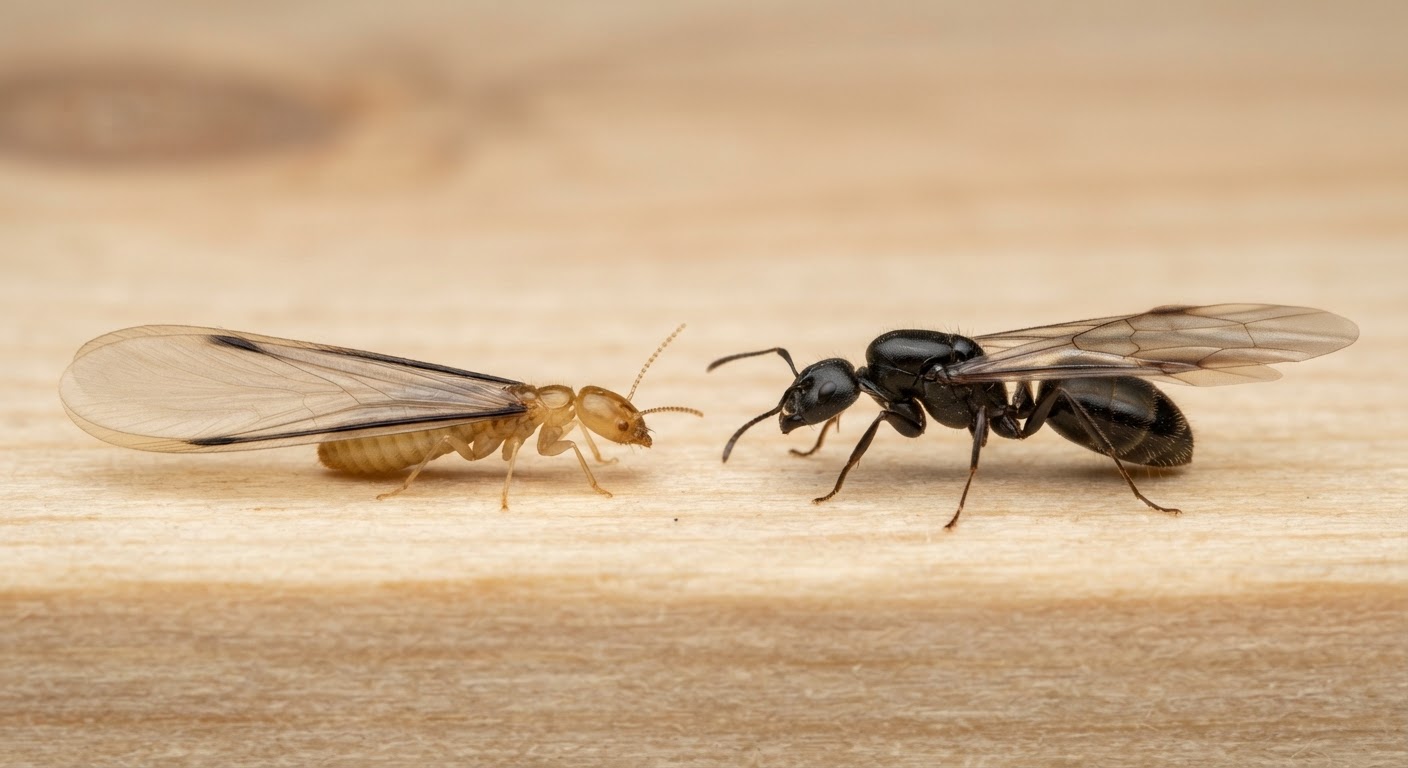
Spring in Middle Tennessee brings warmer temperatures, blossoming landscape plants, and an abrupt awakening of insect activity. For many Brentwood homeowners, this seasonal transition also delivers an unwelcome discovery: dozens or hundreds of small, winged insects suddenly fluttering around window frames, sliding doors, or porch lights. Because subterranean termites and various species of ants enter reproductive swarming phases around the same time of year, it is common to mistake one for the other.
However, telling the difference between a harmless flying ant and a subterranean termite swarmer is critical. While flying ants can be an occasional nuisance or a sign of localized wood nesting, termite swarmers indicate that an active, mature colony is nearby—or potentially within the structural framework of your home. This guide explains how to accurately identify what you are seeing, why these swarms occur, and what steps to take if you find them inside your house.
What Are Insect Swarmers?
In both ant and termite societies, the vast majority of the population consists of wingless workers and soldiers. These individuals spend their entire lives foraging, building, defending the colony, and caring for the queen. Neither worker ants nor worker termites take flight.
Swarmers—scientifically called alates—are the fertile, reproductive members of the colony. Their sole biological mission is dispersal and reproduction. Once a colony reaches a mature size, usually after several years of growth, it produces a generation of winged males and females. When external environmental cues align, typically the arrival of warm weather following a spring rain shower, thousands of these winged insects leave their parent nests simultaneously. They take flight to mate, shed their wings, burrow into the soil or suitable nesting sites, and attempt to establish new colonies.
The Three Key Physical Differences
When you spot winged insects inside or directly outside your home, capturing a few specimens in a clear container or on a piece of clear adhesive tape allows for close inspection. Magnification from a hand lens or a smartphone camera will quickly reveal three distinct anatomical checkpoints.
1. Body Shape and Waistline
The most reliable structural distinction between ants and termites is the shape of their bodies:
- Termites: Termite swarmers have a broad, uniform body shape. Their thorax and abdomen are fused together without a narrow constriction, giving them an oblong, rectangular, or cigar-shaped appearance.
- Ants: Ants possess a distinct, pinched waist between the thorax and abdomen (known as a petiole). This gives them an hourglass-like silhouette with three clearly separated body segments: head, thorax, and abdomen.
2. Antenna Shape
Looking closely at the insect's head reveals a clear contrast in the structure of the antennae:
- Termites: Termite antennae are straight and resemble a tiny string of miniature beads stacked together.
- Ants: Ant antennae are sharply elbowed or bent at an angle, similar to a human arm bent at the joint.
3. Wing Size and Symmetry
Both insects have two pairs of wings (four wings in total), but the proportion and durability of those wings differ significantly:
- Termites: Both pairs of termite wings are identical in size, shape, and delicate veining. The wings are translucent, smoky gray, or milky in color and are roughly twice the length of the insect's actual body. Furthermore, termite wings are weakly attached and fall off easily once the insect lands.
- Ants: Flying ants have unequal wings. The forewings (front pair) are distinctly larger and longer than the hindwings (back pair). Ant wings tend to be sturdier, feature more defined, darker veins, and remain attached to the insect much longer after flight.
Behavioral and Environmental Clues in Middle Tennessee
While physical anatomy provides definitive proof, context and behavior also offer valuable clues. In Middle Tennessee, local weather patterns and specific indoor locations provide hints about which pest you are facing.
The Presence of Discarded Wings
Finding a pile of discarded wings on a windowsill, inside a bathtub, or along a baseboard without many intact insects is a hallmark sign of termite activity. Because subterranean termites intentionally break off their wings immediately after landing to crawl into soil or crevices, piles of small, silvery wings are often the only visible evidence left behind hours after an indoor swarm occurs. Ants, by contrast, keep their wings for extended periods, meaning you are far more likely to find intact, dying ants rather than isolated wing piles.
Seasonal Timing
In Brentwood and surrounding areas, eastern subterranean termites generally swarm from late March through May. These swarms almost always occur during bright, warm mornings or early afternoons following a day of heavy rainfall. Some ant species, like carpenter ants or pavement ants, may also swarm in late spring, but many common ant species tend to swarm later in the summer or early fall, often in the late afternoon or evening.
Why Subterranean Termites Are a Specific Concern in Brentwood
Tennessee sits within an area designated by entomologists and building authorities as having moderate-to-heavy subterranean termite pressure. Our native eastern subterranean termites thrive in the region's humid climate and moisture-rich clay soils. Because these pests live underground, they require continuous access to soil moisture to avoid desiccation.
When subterranean termites swarm outdoors—such as around an old tree stump or a landscape border dozens of feet from the house—it simply confirms that termites are part of the natural local ecosystem. However, finding swarmers emerging indoors, or seeing dozens trapped against an interior window, strongly indicates that an active colony has breached your home's foundation or crawlspace. Worker termites may have been silently feeding on wall studs, sill plates, or subflooring long before the swarmers emerged to catch your attention.
What to Do If You Discover a Swarm Indoors
Discovering a swarm of insects inside your living area can be alarming, but remaining methodical helps protect your property:
- Do not reach for aerosol bug spray: Spraying over-the-counter insecticides will kill the visible swarmers, but it does nothing to address the thousands of worker termites hidden inside the structural wood or soil below. In some cases, chemical sprays can cause foraging workers to reroute their feeding patterns to other areas of the home.
- Save several specimens: Place a few intact insects or discarded wings in a sealable plastic bag or glass jar. This ensures an inspector can verify the exact species under magnification.
- Vacuum the rest: Use a standard household vacuum to clean up the swarmers and loose wings. Empty the canister or dispose of the vacuum bag immediately outdoors.
- Note the emergence location: Mark or photograph the specific baseboard, trim seam, vent, or light fixture where the insects emerged. This pinpoints critical entry points for further investigation.
- Inspect your crawlspace and foundation: Look along foundation walls, crawlspace piers, and plumbing penetrations for mud shelter tubes—pencil-thick tunnels constructed by subterranean termites to travel safely between the soil and the wood above.
Take the Next Step to Protect Your Home
Whether you are dealing with flying ants nesting near moisture damage or subterranean termite swarmers signaling an active infestation, timely and accurate identification is the only way to safeguard your investment. Granite Finch Pest Control provides thorough residential pest and termite inspections tailored to the unique construction and soil conditions of Brentwood properties. Contact our team today to schedule an inspection and secure your home against wood-destroying pests.
Need help from Granite Finch Pest Control?
Contact our team to discuss your service needs in Brentwood and surrounding service areas.