Liquid Barriers vs. Baiting Systems: Evaluating Modern Termite Defense Strategies
Compare liquid barrier treatments and termite baiting systems to understand how each strategy protects Brentwood homes from subterranean termite damage.
The Challenge of Subterranean Termites in Middle Tennessee
Subterranean termites are an ever-present concern for property owners across Middle Tennessee. In areas like Brentwood, the combination of warm summers, adequate annual rainfall, and rich soil creates an ideal environment for subterranean termite colonies to thrive underground. Because these wood-destroying insects live in subterranean nests and forage silently through the dirt, they can compromise the structural framing of a building long before any outward symptoms appear.
Protecting a structure against termites requires a proactive, reliable exterior defense. Modern professional pest management primarily relies on two proven methodologies: liquid chemical soil barriers and in-ground baiting systems. While both strategies are engineered to stop subterranean termites from feeding on structural timbers, they operate on distinct scientific principles, require different installation procedures, and perform differently depending on the property's architectural profile. Understanding the mechanics, benefits, and limitations of each approach helps homeowners make informed decisions for long-term defense.
Understanding Liquid Termite Barriers
Liquid termite treatments have been the traditional cornerstone of termite defense for decades, though the chemistry powering them has evolved significantly. Older treatments historically relied on repellent chemicals designed to push termites away from a foundation. If even a narrow gap occurred in that treated zone, however, foraging termites could find the opening and breach the structure.
Today's professional liquid treatments utilize non-repellent termiticides. Because subterranean termites cannot detect the presence of the product in the soil, they travel directly through the treated zone. As they move through the treated soil, the active ingredient adheres to their bodies and is ingested through routine grooming. Due to the social, communicative nature of termite colonies—which share food through a process called trophallaxis—exposed workers unwittingly transfer the termiticide to nestmates, leading to significant mortality within the population.
Application Method for Liquid Treatments
Applying a continuous liquid barrier requires thorough soil saturation around the entire perimeter of the foundation. The process generally involves:
- Trenching: Technicians dig a narrow trench along the exterior foundation walls, applying the diluted liquid termiticide into the soil as it is backfilled.
- Rodding: Deep soil injection rods are used to deliver the product down to the footing level, ensuring continuous subterranean coverage.
- Drilling Hardscapes: Where patios, driveways, carports, or walkways abut the foundation, technicians must drill small, vertical holes through the concrete to inject the liquid termiticide into the soil beneath, afterward patching the holes with concrete plugs.
- Crawlspace Treatment: For homes with crawlspace construction, interior foundation walls and support piers may also require trenching or rodding to address interior avenues of approach.
Advantages of Liquid Barriers
Liquid treatments provide immediate protection. As soon as the chemical application is finished, a complete, continuous envelope of treated soil surrounds the building. Termites attempting to cross that boundary will encounter the material immediately. Furthermore, high-quality modern non-repellent formulations bond tightly with soil particles, offering robust residual effectiveness that can last for several years when undisturbed.
Disadvantages and Practical Considerations
The primary drawback of liquid barrier applications is the level of physical disturbance required during installation. Drilling through finished stone, decorative brick pavers, or stamped concrete patios can be aesthetically disruptive. Additionally, Middle Tennessee features heavy clay soils that can present drainage hurdles; highly compacted or shifting clay can sometimes make uniform chemical saturation more difficult to achieve. Finally, future landscaping activities, such as digging garden beds, installing drainage systems, or planting shrubs near the foundation, can physically disrupt the barrier and create unprotected gaps.
Understanding Termite Baiting Systems
Termite baiting systems represent a behavioral approach to colony management. Rather than creating a static chemical wall around the home, baiting leverages the natural foraging tendencies of subterranean termite workers to deliver a slow-acting insect growth regulator (IGR) directly into the heart of the colony.
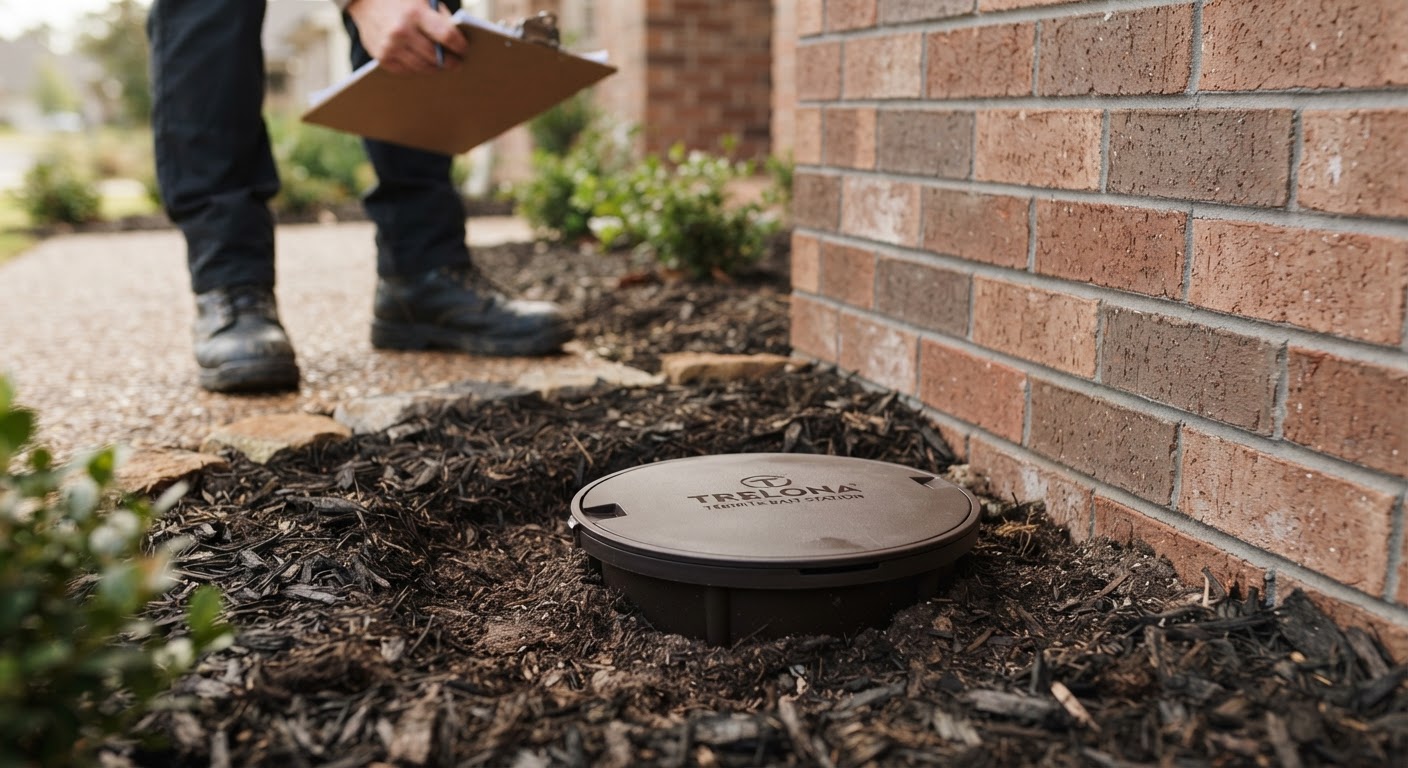
Bait stations are discreet, cylindrical plastic housings installed flush with the ground at measured intervals around the home's perimeter. Inside each station is a cellulose-based matrix that termites find highly palatable, impregnated with an active ingredient that inhibits their ability to produce chitin. Chitin is the fundamental building block of an insect's exoskeleton. When worker termites consume the bait and attempt to molt, they are unable to form a new exoskeleton and perish, causing a gradual collapse of the colony hierarchy.
Application and Maintenance of Baiting Systems
Installing a baiting system is straightforward and minimally invasive. Stations are placed directly into the turf or mulch beds approximately ten to twenty feet apart, surrounding the entire structure. The lids sit flush with the grade, allowing lawnmowers to pass over them without obstruction.
Once installed, ongoing maintenance is essential. Technicians inspect the stations on a routine schedule—typically quarterly or annually, depending on the system design—to check for feeding activity, evaluate bait consumption, and replace depleted bait cartridges. This ongoing cycle of monitoring ensures the system remains functional and active season after season.
Advantages of Baiting Systems
Baiting systems offer several clear operational advantages:
- Minimal Property Disruption: There is generally no need to drill through indoor floorings, finished patios, or porch slabs, preserving decorative hardscapes.
- True Colony Elimination: Because the active ingredients act slowly, workers have sufficient time to distribute the material throughout the deep underground colony network, targeting the queen and reproductive castes.
- Continuous Property Monitoring: Routine station checks provide clear, observable evidence of whether termites are actively foraging near the home, giving homeowners tangible updates on pest activity.
- Environmentally Targeted: Bait stations contain small, contained quantities of active ingredients confined within durable, tamper-resistant cartridges, eliminating the need for broad-scale chemical soil saturation.
Disadvantages and Practical Considerations
The main trade-off with bait systems is time. Baiting is not an instant barrier; it relies entirely on foraging termites finding the stations during their natural search for food. While subterranean termites forage randomly and continuously, it can take weeks or months for workers to locate a station, feed heavily, and transfer the regulator to the broader nest. Consequently, if a home is experiencing an acute, active infestation inside the living space, relying solely on bait stations may allow feeding to continue while the colony slowly declines.
Direct Comparison: Key Factors for Brentwood Homes
Choosing between a liquid barrier and a baiting system often depends on specific property characteristics, foundation types, and personal preferences.
Foundation Type and Hardscape Design
Many residences in Brentwood feature extensive outdoor living spaces, including wrap-around concrete porches, swimming pool decks, retaining walls, and elaborate perimeter landscaping. Drilling through these expensive, high-end materials to install a liquid barrier can be undesirable. In these situations, bait stations placed neatly in adjacent landscape beds provide an unobtrusive solution that protects the structure without altering the stonework.
Conversely, for a home with accessible soil surrounding an unfinished crawlspace, a liquid barrier can be placed directly against the foundation walls with minimal disruption to finished surfaces.
Soil Composition and Topography
Middle Tennessee soil is notorious for its dense clay content and rocky limestone sublayers. Heavy clay does not absorb water quickly, meaning liquid applications require careful, methodical injection to avoid surface runoff and achieve an even saturation depth. Bait stations, while requiring holes augered into the ground, bypass soil absorption issues entirely because the attractant and active ingredient are contained within the station capsule itself.
Speed of Interception vs. Long-Term Nest Eradication
If an inspection reveals termites currently feeding within structural sill plates or subflooring, speed is critical. A liquid treatment can halt perimeter entry rapidly. However, a liquid barrier does not necessarily eliminate the parent colony deep underground; it primarily excludes them from the footprint of the home. Baiting systems take longer to demonstrate results, but they actively destroy the source population, reducing the overall termite pressure on the entire parcel of land.
The Integrated Approach: Combining Strategies
Modern termite control does not always force an exclusive choice between liquids and baits. In many circumstances, pest management professionals employ an integrated defense strategy that draws upon the strengths of both tools.
For instance, if an active infestation is identified inside a wall void, a professional might perform a targeted, localized liquid or foam application to immediately arrest structural destruction at the breach point. Simultaneously, an exterior baiting perimeter can be deployed around the property to locate and eradicate the subterranean colonies responsible for the pressure. This hybrid approach pairs the swift protective interception of liquid chemistry with the long-term, comprehensive elimination power of subterranean baiting.
Determining the Right Strategy for Your Property
Every home presents a unique combination of construction details, landscape features, and environmental moisture levels. A sprawling home on a slab foundation flanked by flagstone patios has different defensive requirements than a home set over an open crawlspace on a sloped, wooded lot. Selecting the proper defense strategy requires a comprehensive on-site assessment by an experienced technician who understands the behaviors of Middle Tennessee subterranean termites.
Protect your investment with a tailored termite defense strategy. Contact Granite Finch Pest Control to schedule a thorough structural inspection and find the ideal protection plan for your Brentwood home.
Need help from Granite Finch Pest Control?
Contact our team to discuss your service needs in Brentwood and surrounding service areas.